
A new epistemology?
 Professor Tim Clydesdale has written an interesting piece in the Chronicle of Higher Education in which he suggests a new epistemology is dominant in the universities of America. There are echoes of Allan Bloom's 'Closing of the American Mind' here, as he suggests that today's university student sees knowledge as something to be approached more democratically, with less acceptance of expert knowledge, and not necessarily an acceptance of traditional notions of 'knowledge for knowledge's sake', 'the transformative power of the liberal arts' and so on. This he rightly suggests represents a challenge to university educators. Since it's a higher education opinion piece he doesn't try to outline in detail his view on this presumed epistemology its philosophical foundations, but one part of his stimulating commentary caught my attention and intersected with the observations of many that notions of 'truth' and textual authority continue to be challenged (see for example my posts on 'Truth and the Internet' here and here). Many of us have observed how younger generations in particular (but not exclusively) no longer place as much credence on authoritative texts nor supposed knowledgeable people. It seems experience, credentials, publications and even position carry little value for younger generations who are quick to say 'So what?' 'I'm not so sure about that' or 'Well that's one opinion among many'. He wrote:
Today's students know full well that authorities can be found for every position and any knowledge claim, and consequently the students are dubious (privately, that is) about anything we [academics and scholars] claim to be true or important.
 In a piece that was published in Case 15 (here), I commented that for the postmodern person, knowledge, varies with the individual, circumstances and time and leads to the catch cry, ‘that might be true for you, but not for me’. Just as the serpent in the Garden of Eden suggested to Adam and Eve that they could have access to all the knowledge that God possessed as creator (Genesis 3:1-5), the deconstructive postmodernist (a term that I think comes closest to describing Clydesdale's 'new epistemology') suggests that we can have access to the tree of knowledge because we create it, it is in us.
While accepting that it is good to question knowledge and that some would see this more pluralistic view of knowledge as a good thing, Clydesdale contrasts this new attitude to that of students in an earlier age who were prepared to accept the authority of teachers and university professors more readily. He continues:
"Of course, this new epistemology does not imply that our students have become skilled arbiters of information and interpretation. It simply means that they arrive at college with well-established methods of sorting, doubting, or ignoring the same."
In my earlier Case 15 article I also pointed out that the process of democratisation of knowledge, has led to the creation of new interpretive communities where ideas are shared, interpretations are co-constructed and knowledge in turn is shared with others. Barthes wrote of the ‘death of the author’ over forty years ago, so this is not a new development, although I would agree with Clydesdale that it is a more common epistemological starting point than it was once. But for me, what have had the greatest impact have been the social changes inherent in modern western societies in combination with new forms of communication. The changing nature of families and their instability has meant that peer groups are now more important sources of advice, support and knowledge than was once the case. And while one could not blame new communication technology for the undermining of political, parental, teacher, police or scholarly authority, its development has accompanied significant social changes to families and the place of the church, and increasingly pluralistic societies precipitated by increasing globalisation, occurring at the same time that post modern thinking had taken hold of the academy (something that many argued is now changing).
The Internet continues to add weight to and support this shift from authorial and textual power to the reader/student and their interpretive communities. In particular, the Internet has done much to negate individual authorship in favour of shared authorship. Phenomena such as Wikipedia make it increasingly difficult to identify a single author and in effect supports the notions of the young that they will weigh every issue up, not just accept your view even if you're a teacher, professor, politician or even their mum. Once again, we need to recognise that universities, schools and families should be places where we encourage the young to question, argue and explore ideas. But what does this mean for the way we approach a different generation?
Clydesdale's conclusion is that we should approach our students with greater respect and with patience:
"The onus is on us to better convey the value that a robust intellectual life adds to the public good. And we need to begin by respecting our students (and the wider public) not just as persons but as the arbiters of knowledge that they have become. Specifically, we must respect students as thinkers, even though their thinking skills may be undeveloped and their knowledge base shallow. Moreover, our respect must be genuine. Students have keen hypocrisy sensors and do not like being patronized."
I find this a challenge, but I think there is great wisdom in what he is suggesting. While I will never retreat from my belief that there are truths which I will defend vigorously (most notably, biblical teaching and the gospel of Christ), nor will I compromise in watering down or sanitising the message of the gospel, we do need to consider how we engage with such a different generation whether as an academic, teacher, parent or preacher. Clydesdale's point intersects with the views of others in recent times including John Stackhouse who points out in his book Humble Apologetics that “If we are going to defend and commend our faith, we must do it in a new mode: with a different voice and in a different posture. Our apologetics must be humble.”
Clydesdale finishes with these helpful words:
"Some of us need an attitude adjustment. It is not just residential-college students who live in a bubble — many faculty members do as well. We take for granted our privileged status, become consumed by petty controversies, talk only to ourselves, and ignore the wider public that makes our work possible. It is tempting, I know, to want to curse the culture and withdraw into like-minded enclaves. But neither catharsis nor retreat will satisfy those who demand accountability, raise financial support for public higher education, or generate more students who cherish college as an opportunity to learn and think."
 While Clydesdale was writing this article for a general higher education academic readership, we could also redirect his thoughts to any of us would be apologists and even preachers. This is something that Tim Keller considers at length in his excellent book The Reason for God, which I reviewed on this blog (here). The message of the gospel must not be sanitised or modified for this generation, but we must give careful consideration to how we engage a questioning generation in a consideration of the truth.
You can read Clydesdale's excellent piece here.
Leave a comment
Comments will be approved before showing up.
Also in And Just in CASE
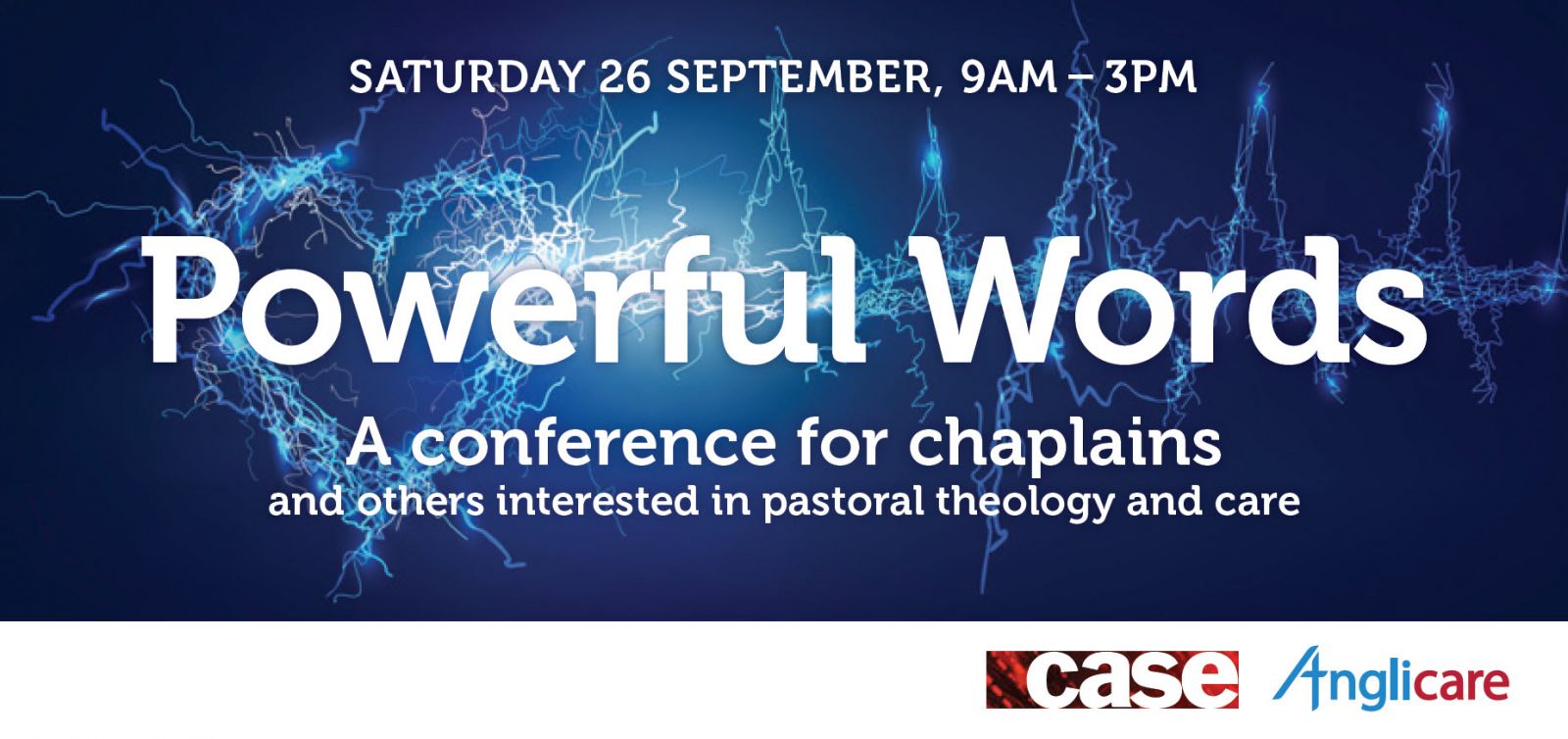
Powerful Words: The Key Role of Words in Care
The Bible's Story

In the beginning was the Word, but it took a while for the hundreds of thousands of words in the Bible to be composed, written down, painstakingly copied, preserved, passed around, tested, accepted, collected together,...
Sign up to get the latest on sales, new releases and more …
© 2026 CASE.
Designed by Out of the Sandbox.
Powered by Shopify


