
A fruitful universe†

Image: NASA, ESA, and P. Crowther (University of Sheffield). The central region of the Tarantula Nebula in the Large Magellanic Cloud.
Jennifer Wiseman
Astronomer Jennifer Wiseman takes us on a brief tour of the universe, to show us some of what scientists have been discovering and share the wonder she feels at what we find beyond our own planet.
***
Our universe is amazing, and we’re part of it. Sadly, urbanisation and light pollution mean that fewer and fewer people are walking outside at night and being awestruck at the night sky, and yet this is a significant part of our human experience. At the same time, improvements in technology mean the images from our telescopes are getting so good, and the internet allows us to distribute them so easily, that anyone with access to the internet can now view magnificent images of space well beyond what people have been able to see in the past. We’re almost so spoiled to see these, that we don’t realise what a privilege it is!
I. Discovering the universe
Astronomers use different kinds of telescopes to gather different information and study the universe in detail—such as radio telescopes, visible light telescopes, and infrared telescopes; some are on the ground and some in space. Launched from the Space Shuttle in 1990, the Hubble Space Telescope, for example, has allowed us to see into space in a way that was never possible before. It has been visited by astronauts for repairs and upgrades several times, and so it is now an even better telescope than it was originally. The images and data it has provided have changed the way we understand our universe.
Powerful telescopes allow us to see images like this region of star formation (above). We now know that stars are continuing to form vigorously in our own galaxy, and in other galaxies too. These galaxies are filled with gas and dust. The turbulent motion of this gas and dust tends to keep things from collapsing, but if an eddy of gas forms it can collapse under its own gravitational pull. Where enough of this interstellar gas collapses into a small enough volume, an enormous amount of pressure results. Massive amounts of gas, mostly hydrogen, are compressed into a very small volume, and this enables reactions called fusion at the core of this compressed ball of gas: through a series of reactions, hydrogen atoms fuse and produce helium and other products including photons of light. When the light photons make their way out, we have the birth of a star.
A star, then, is a fusion reactor. As well as helium, the fusion reactions eventually produce heavier elements like carbon, oxygen, and iron—these are all produced in stars. The most massive stars also emit powerful light and generate winds that, over time, blow away the remaining gas out of which the stars have formed, so we often see regions like this of bright newly-formed stars surrounded by colourful lit-up remnants of gas being blown away.
The beautiful universe
It is worth pausing to contemplate the sheer beauty of this, and other images we have of space, and to be thankful for the opportunity to see such magnificent scenes.
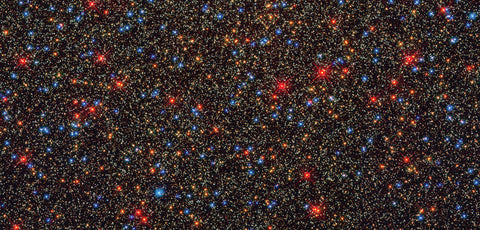
Image: NASA, ESA, and J. Anderson and R. van der Marel (STScI)
A crowded field of stars at the heart of Omega Centauri.
Above is an image of the core of a very dense globular cluster of stars in our galaxy known as Omega Centauri. Most telescopes on the ground, looking through Earth’s turbulent atmosphere, would see a blur of blended light in this region. But this crisp image, taken from the Hubble Telescope’s orbit above the atmosphere, reveals in high resolution many different kinds of stars—red, blue, white, yellow. The colours are caused by different temperatures on the outside atmospheric layers of the stars. If our sun were here, it would be like one of the small stars appearing white here.
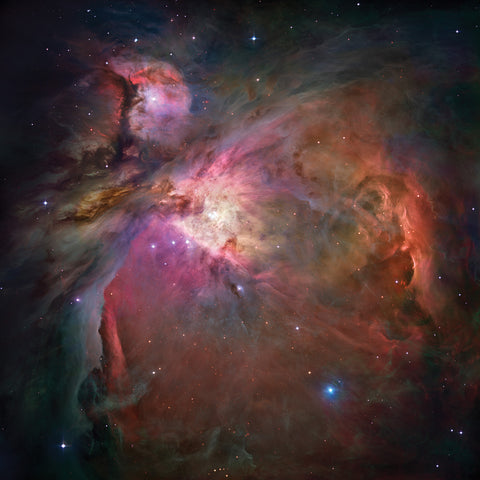
Image: NASA,ESA, M. Robberto (Space Telescope Science Institute/ESA) and the Hubble Space Telescope Orion Treasury Project Team.
The Orion Nebula, located 1,300 light-years away, is the nearest area of high-mass star formation to Earth.
This colourful star-forming region, the Orion Nebula (above), is another beautiful sight. The gas is lit up in these beautiful colours because massive stars—much bigger than our own sun—have already formed out of it. The wind coming off these is blowing away the surrounding gas, but in the meantime one of these massive stars is powerful enough that its radiation ionises the gas. This means the photons of light hit the atoms of gas and temporarily separate the electrons from the nucleus of the atom. When these atoms recover, they release colourful light. So when we see colourful light like this in space, it’s a sign that star formation is taking place.
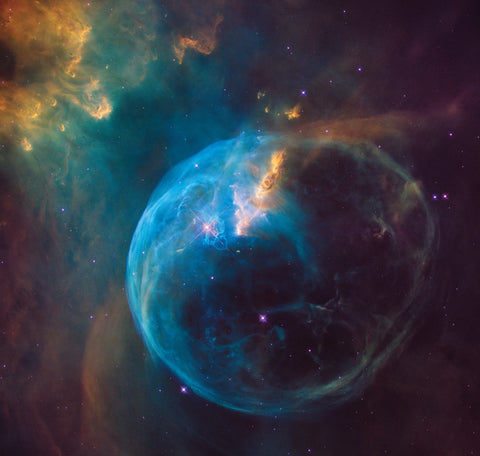
Image: NASA, ESA, and the Hubble Heritage Team (STScI/AURA).
The Bubble Nebula.
Older stars are beautiful too. Stars become unstable when they start running out of the inner hydrogen that’s creating the fusion process that emits light. When that instability sets in, the stars start releasing their outer atmosphere. We see this starting to happen in this image of the Bubble Nebula (above).
The active universe
The universe is beautiful, and it is also active, ever changing. New worlds are continually being born, and old ones dying.
Often in regions of stellar birth, pillar-like structures can be seen. These are carved out when recently formed massive stars, which form very fast (relatively speaking), send out wind and radiation and start blowing away the leftover gas. The denser clumps of gas stay around for longer, and protect the regions behind them, creating columns.
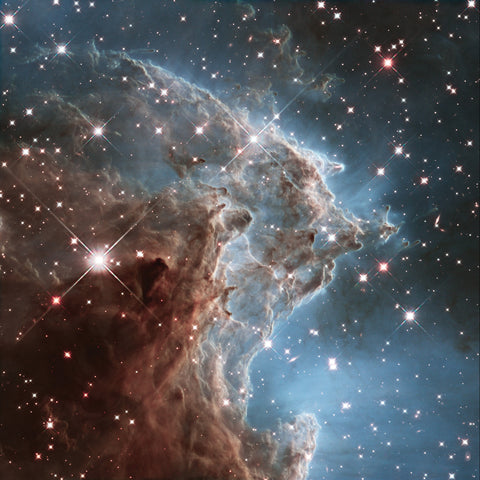
Image: NASA, ESA, and the Hubble Heritage Team (STScI/AURA).
A small portion of the Monkey Head Nebula, a star-forming region.
In this image of the Monkey Head Nebula (above) the massive young stars are off to the right and out of the frame. The winds coming off them form the pillar-like structures pointing back towards these massive stars. Lower mass stars take longer to form, and are often still forming in these column-like structures.
The image below shows a star being formed in the Orion Nebula. The infant star is surrounded by a dark disk-shaped region, about the diameter of our solar system.
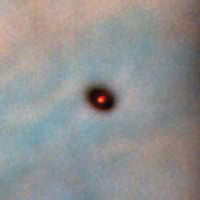
Image: Mark McCaughrean (Max-Planck-Institute for Astronomy), C. Robert O’Dell (Rice University), and NASA.
A close-up of a protoplanetary disk within the Orion Nebula.
These circumstellar disks were a surprise when first seen around 30 years ago. We now know that nearly every star forming in our epic of time forms with a disk of dusty solid debris around it. Initially the disk is predominantly gas, but over time the gas dissipates, leaving behind the dusty or rocky components. It is out of this material in these regions that planets are formed, and we understand now that planet formation goes hand in hand with star formation—a hot topic in astronomy at the moment!
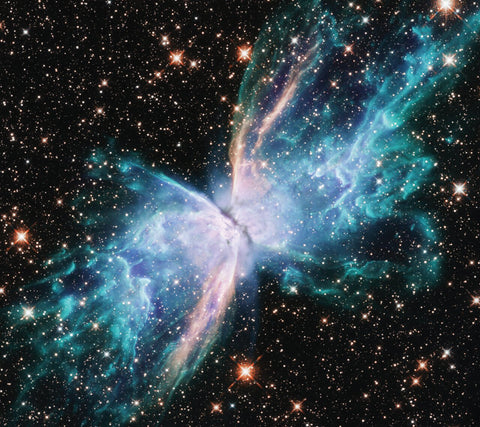
Image: NASA, ESA, and J. Kastner (RIT).
The Butterfly Nebula in the constellation Scorpius.
The end state of stars is also an active period. The Butterfly Nebula (above) is an old star losing its outer atmosphere as it ages. Here the dying star is hidden within a dusty disk, which is channelling the outflowing atmosphere into two spreading lobes that look like butterfly wings! The material being expelled by the star into the interstellar medium—the surrounding gas clouds that fill the space between stars—includes the heavy elements that were made in the star or ‘fusion factory’.
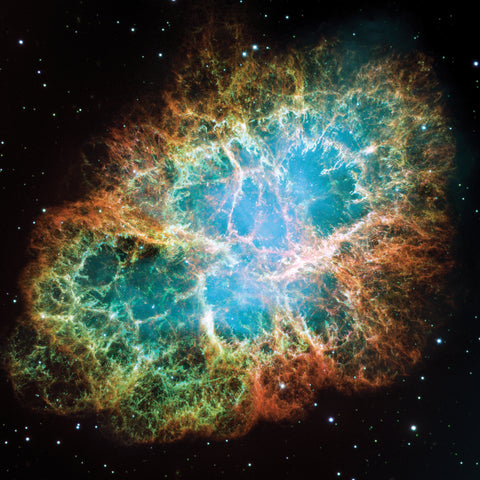
Image: NASA, ESA, J. Hester and A. Loll (Arizona State University).
The Crab Nebula, a 6-light-year-wide expanding remnant of a star’s supernova explosion.
An even more dramatic example of this is the supernova remnant called the Crab Nebula (above). It is the debris of a massive star that exploded around 1000 years ago, an explosion that was seen from Earth. The different colours are emitted from the different elements forged within the star and its explosion—oxygen, carbon, nitrogen, silicon. This material will get mixed in with the interstellar hydrogen gas, and subsequent generations of stars and their surroundings will be enriched with it. Over generations of stars being born and dying, the later generations of stars form with circumstellar disks that include this heavier material that can make solids and planets.
Galaxies are collections of stars, gas, and unseen dark matter, and they are the sites of all this activity. When they come into close enough proximity, galaxies can coalesce, and this appears to have been a common occurrence over the history of the universe. Most galaxies, like our own, appear to be mergers of a number of galaxies over the long distant past, as evidenced by finding different populations of stars within the same galaxy.
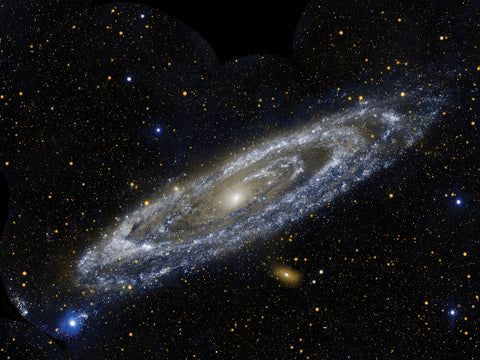
Image: NASA/JPL-Caltech.
The Andromeda Galaxy
The Andromeda Galaxy (above) is the nearest neighbour to our own Milky Way. Astronomers realised a few years ago that the two are on a head-on collision course, which will result in the two merging. Computer modelling suggests that our solar system won’t be too impacted by this, but our night sky will look completely different in about 3.5 billion years—something to keep an eye out for!
The vast universe
As well as being beautiful and active, the universe is vast, in terms of space and time, and also in the number of stars and galaxies we see.
For about a century now, we’ve known that there are galaxies other than our own. Before that, it was generally believed that all the stars in the universe were in one galaxy, the Milky Way. But astronomer Edwin Hubble identified the Andromeda Nebula as an external galaxy in the early 1920s, and by the end of the decade had identified several more. Suddenly the universe was much bigger than we’d thought.
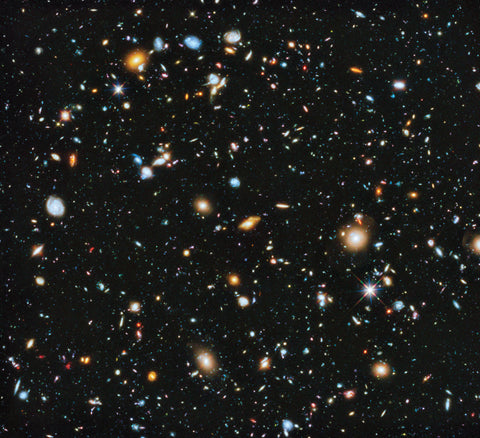
Image: NASA, ESA, H. Teplitz and M. Rafelski (IPAC/Caltech), A. Koekemoer (STScI), R. Windhorst (Arizona State University), and Z. Levay (STScI).
Hubble Ultra Deep Field. 2014.
This ‘ultra-deep’ image of the distant universe (above) was taken by the Hubble Telescope in 2014. Light was collected from an area of the sky smaller than the size of the cross-section of a drinking straw for several days, so that very faint objects could appear. Almost all the blips of light in this image are entire galaxies, not stars within our own Milky Way. If we take this picture, and mentally extrapolate it over the whole sky, we start to get an idea of the size and richness of our universe; looking in any direction reveals a similar plethora of galaxies. Hundreds of billions of galaxies in the visible universe. Billions of stars in each one. And possibly planets around most of those stars. It’s mind-boggling. And these galaxies are at vast distances, some more distant than others.
Astronomy is a time machine. It has taken time for the light from everything we can see in space to get to us. As our telescopes allow us to see things that are farther and farther away, we are also looking farther and farther back in time. Various lines of evidence suggest our universe had a spectacular beginning around 13.8 billion years ago. We can now see back into the first ‘0.8’ of that 13.8 billion years of history, to when baby stars and galaxies are beginning to form and coalesce.
We see galaxies as they were when their light began its trek to us. This allows us to compare younger galaxies, at a great distance as they formed earlier in the universe, with older galaxies closer to us in space and time. We find that younger galaxies from earlier in the universe are smaller, not yet having merged much with others, and they have irregular shapes because they haven’t had time yet to develop the spiral structure seen in more mature galaxies that results from rotations and pressures. Also, younger systems are made up of stars that have a simple composition, primarily hydrogen, while over time the composition of newer stars changes to include more of the heavier elements that formed in earlier generations of stars. Once we have generations of stars coming and going and producing carbon, iron, oxygen and the like, we get galaxies like our own. The stars are still mostly hydrogen, but they also contain a lot of the other things within and around them—the things we need to make planets, and the things we need for life.
So what we see through the ‘time machine’ of our telescopes is that the universe has developed over billions of years, and it continues to mature and change. Stars and galaxies are produced, and the stars produce heavier elements that allow later generations of stars to form with these elements in disks around them. This in turn allows planets to form. These planets and heavier elements provide the conditions needed for life to thrive—at least on one planet! And maybe on other planets too. Our universe is a wonderful place for life.
Does this imply the universe has a purpose? The purpose to bring forth life?
II. Beyond the science
Does the universe have a purpose? That is a kind of question that is beyond what science alone can answer. People can understand and agree on what science is teaching us about the universe, but come to different conclusions on philosophical questions such as whether there is a purpose behind it.[1]
The perspective of faith
How does a biblical view of the cosmos relate to our scientific view? It’s important to remember that science is good at answering questions about physical cause and effect, how things work physically in the universe, and when they happened. But science is not designed to address bigger questions about why the universe is here, in terms of its purpose, or the existence of God, or how I should live my life. To answer these philosophical, theological, and moral questions, we need different tools. As a Christian, I believe the revelation of God, found especially in the person of Jesus Christ and the Bible which testifies to him, is key for answering these questions. In the person of Jesus, God actually entered the cosmos, becoming a human and living among us (with a body containing atoms made in stars, like ours!). In fact the Scriptures go even farther, and say that the universe was created through him, for him, and is upheld by him![2] It is through him that we find a connection to God—a person who is the source of all wisdom and all understanding and all life.
Sometimes there are difficulties in reconciling the conclusions of theology and of science. A good model for dealing with these conflicts was enunciated by scientist Francis Bacon, who recognised there are ‘two books’— the book of Nature, and the book of Scripture. Both are sources of God’s revelation and truth, despite having different goals, and so properly understood are not in conflict. However, both observations of the natural world and Scripture are interpreted by humans—giving us the human enterprises of science and theology. Scientific and theological conclusions can be mistaken or incomplete, and so can and do sometimes come into conflict and need to be revised and refined. The strategy to follow when we encounter such an apparent conflict is not, therefore, to hold to one source and reject the other, but to hold both provisionally and dig deeper, following lines of evidence.[3]
Can the universe tell us anything about God? Science can’t prove the existence of God, or give us scientific conclusions about what God is like—it’s the wrong tool for this enquiry. But looking at the universe from a faith perspective, we can draw some inferences from the character of the heavens, to the character of its creator:
- Powerful, wise, creative—the fact that stars themselves create the elements that are needed for planets and life, for example, is amazing!
- Values beauty.
- Patient—the unfolding of the universe to this point has taken billions of years.
- Faithful—there are fundamental laws that are constant and don’t change randomly, so we can have meaningful lives with cause and effect. And yet within this there is a basic context for freedom—even within the physical principles of our universe such as quantum mechanics.
- Love—a universe that enables life could indicate love: that God wants creatures to exist who can appreciate the magnificent cosmos of which we are a part. Even the fact that we can recognise suffering and evil and injustice hints that our creator cares and grieves at such pain as well.
Of course, these are inferences—others might come up with a different list. For more direct knowledge of God and his relationship to the natural world, we can look to the Bible where a number of themes are evident:
- God is responsible for the heavens and everything we find in nature.
- The natural world gives God glory—most of the mentions of the heavens in the Bible are in the context of praise.
- God is pleased with our discovery and good stewardship of the natural world.
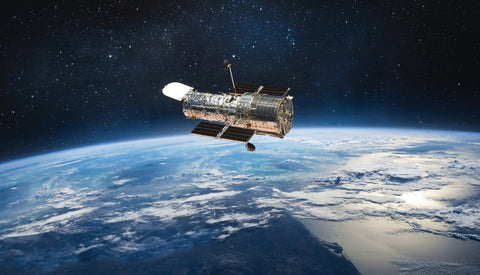
Hubble Space Telescope in orbit of planet Earth.
Contemplating the universe can also raise questions about us—who we are. What can we infer about our significance, given the vastness of the universe? Again, perspective makes a difference. Compare the following quotations:
Who are we? We find that we live on an insignificant planet of a hum-drum star lost in a galaxy tucked away in some forgotten corner of a universe in which there are far more galaxies than people.[4] (Carl Sagan)
When I consider your heavens,
the work of your fingers,
the moon and the stars,
which you have set in place,
what is mankind that you are mindful of them,
human beings that you care for them?
You have made them a little lower than the angels
and crowned them with glory and honour.
You made them rulers over the works of your hands;
you put everything under their feet.[v] (Psalm 8:3-6)
Both authors reflect on the smallness of humans in an enormous universe. Astronomer Carl Sagan infers that our planet is insignificant, our corner of the universe ‘forgotten’—and by implication so are we. The Psalmist, however, believing that God has made humanity for a purpose, marvels that God could care so much about this tiny part of the universe and give it such disproportionate significance.
Responding to the universe
The faith perspective has implications for how we should respond to the astounding, beautiful, active, vast universe.
We should praise God as creator, and humble ourselves in awe at God’s power and greatness. We should be thankful for this beautiful little life-supporting planet that we live on in this vast universe. We should care for it and the other inhabitants, both people and animals, as good stewards. And we should be curious and continue to explore it, gaining an even greater appreciation of God’s creation. There’s a lot left to learn.
Dr Jennifer Wiseman is an astrophysicist, speaker, and author. She studies how stars form in our galaxy using radio, optical, and infrared telescopes. She also directs the Dialogue on Science, Ethics, and Religion (DoSER) for the American Association for the Advancement of Science. She is a senior astrophysicist at the NASA Goddard Space Flight Center.
ENDNOTES
† This article is an adaptation of an ISCAST-CASE lecture delivered by Dr. Wiseman at New College in 2018. The full presentation can be viewed https://www.case.edu.au/blogs/case-subscription-library/investigating-a-fruitful-universe-iscast-case-lecture.
[1] E.g. The Templeton Foundation asked leading thinkers ‘Does the universe have a purpose?’ and a wide range of answers were given. Participants wrote explanations for their answers, which can be found at quantumguru.files.wordpress.com/2013/04/161.pdf (accessed March 2022).
[2] Colossians 1:15-17; Hebrews 1:2-3
[3] For a more detailed formulation of this model, with examples showing how it works in practice, see D. B. Haarsma & L. Haarsma, Origins (Faith Alive Christian Resources, 2011).
[4] Carl Sagan, Cosmos (Random House, 1980), p193.
[5] The dominion expressed here does not give humanity the right to exploit creation, but the responsibility to manage, steward, and explore it.
Leave a comment
Comments will be approved before showing up.


Sign up to get the latest on sales, new releases and more …
© 2026 CASE.
Designed by Out of the Sandbox.
Powered by Shopify


